

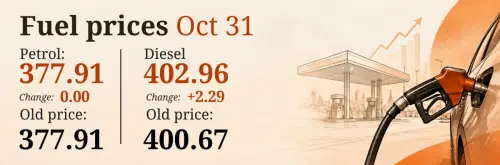
Petrol pricing changes may cause refineries Rs49/litre loss

ISLAMABAD: The government’s latest changes to the pricing mechanism of Motor Spirit (MS/petrol) are likely to impose an estimated financial loss of Rs49 per litre on domestic refineries, raising serious concerns about the viability of multibillion-dollar refinery upgradation projects involving an estimated investment of USD5-6 billion.
In a communication with government, Adil Khattak, Chief Executive Officer of Attock Refinery Limited (ARL), informed that the decision to incorporate pre-war premiums and incidentals into the MS pricing mechanism would cost refineries approximately Rs35 per litre.
An additional diversion of Rs14 per litre from their customs duty recovery towards reducing the Petroleum Levy would take the total adverse financial impact to Rs49 per litre, he said.
READ ALSO: Petroleum Division revises petrol pricing mechanism
Khattak expressed serious concern that the decision had been taken without consultation with the refining industry, despite the sector having already made substantial concessions to the government on two occasions by agreeing to cap its spread on High-Speed Diesel (HSD), initially at USD41.89 and subsequently at USD38.
He maintained that the latest decision directly undermined the Brownfield Refineries Upgradation Policy, which specifically provided for depositing proceeds from the 10 percent customs duty into dedicated refinery accounts to partially finance their upgradation projects.
“Diverting these funds for other purposes defeats the very objective of this provision,” he observed.
The ARL chief executive also pointed out that the government’s move undermined an explicit assurance under the policy protecting refineries against adverse changes during the project execution period.
According to him, such assurances were fundamental to establishing the financial viability and bankability of multibillion-dollar refinery investment projects.
He described the sudden change in the MS/petrol pricing mechanism on October 30, 2026, as a major setback for Pakistan’s refining sector, which had finally been preparing to undertake ambitious upgradation projects after years of policy uncertainty and delays.
Four refineries signed their Upgradation Agreements on September 24, 2026, while the fifth refinery, PARCO, was expected to join the programme shortly.
This followed the long-awaited final approval of the Brownfield Refineries Upgradation Policy after years of delays. According to the ARL chief, each year’s delay had cost the national economy an estimated USD1.5 billion.
Khattak said the timing of the government’s decision was particularly concerning as refineries were currently engaged in extensive discussions with local and international financial institutions to mobilise the enormous funding required for the projects.
These investments are unprecedented in Pakistan’s industrial sector in terms of both technical complexity and financial magnitude, he added.
He warned that an arbitrary change in the agreed financial framework after the signing of formal upgradation agreements raised serious questions about policy consistency, regulatory certainty and the credibility of government commitments.
The decision could undermine investor and lender confidence at a critical stage when refineries were attempting to secure financing for their projects.
The ARL chief executive further questioned the manner in which the decision had been taken, saying neither the government nor the Petroleum Minister apparently considered it necessary to consult the industry that would bear its financial consequences.
He noted that the Petroleum Minister had otherwise demonstrated an understanding of and supportive approach towards the refining sector.
The latest development has raised concerns over the financial commitments made by refineries under the Brownfield Refineries Upgradation Policy, particularly given the substantial investment required to upgrade existing facilities, improve operational efficiency and enhance the quality of petroleum products.
The refineries had relied on the policy framework and associated fiscal incentives while making their investment decisions. Any unilateral alteration in the agreed financial arrangements could therefore affect the implementation of their upgradation programmes.
After nearly seven years of policy formulation, repeated amendments and prolonged uncertainty, the refining sector had finally reached the implementation stage of investments of historic significance.
Khattak urged the government to urgently revisit its decision, engage meaningfully with the refineries and ensure that the financial framework and protections promised under the Brownfield Refineries Upgradation Policy were fully honoured.
He warned that another setback could jeopardise projects that had already suffered years of costly delays and were considered essential for Pakistan’s long-term energy security.
Copyright Business Recorder, 2026

















Comments